


VisiPlate: a brighter future for glaucoma patients
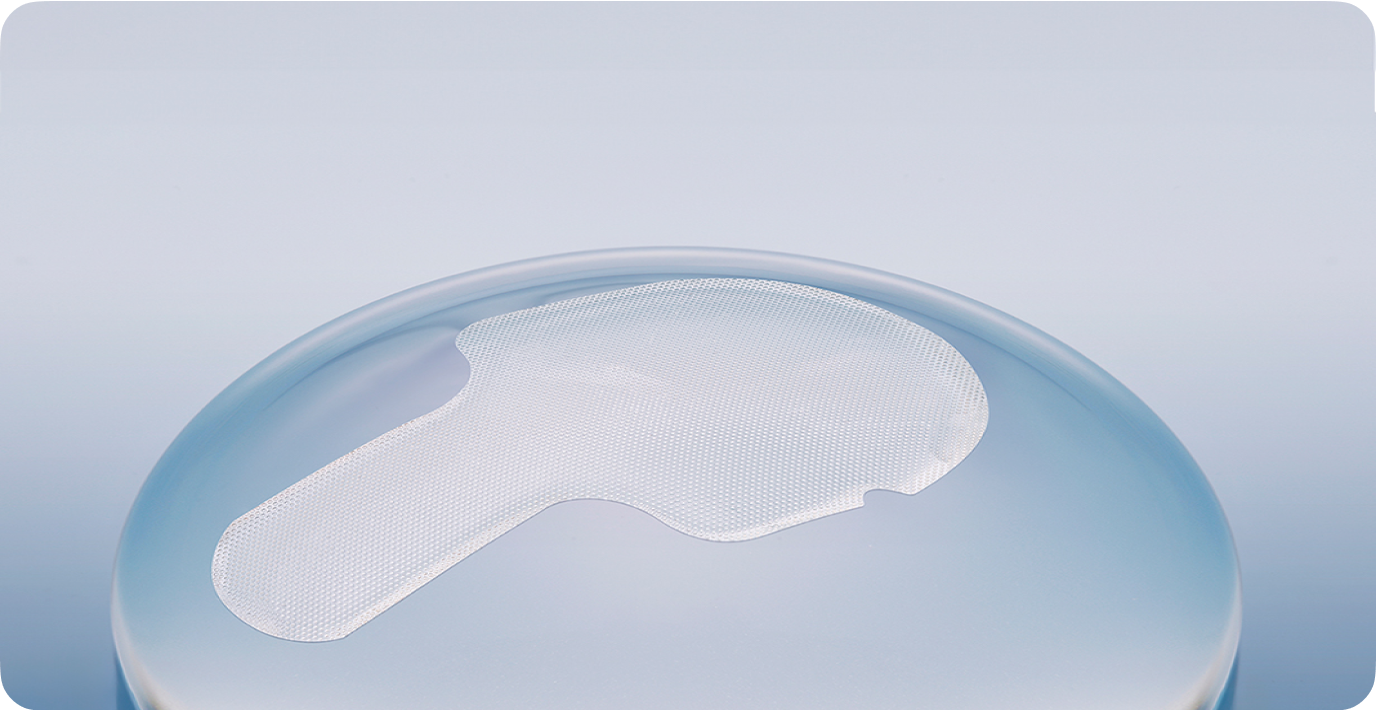
About VisiPlate
- Multichannel – VisiPlate is designed to lower eye pressure through a network of microchannels that control aqueous drainage from the anterior chamber.
- Ultrathin – VisiPlate is several times thinner than a human hair. VisiPlate leverages an ultrathin material with the goal of achieving greater patient comfort and aesthetics.
- Innovative Composition – VisiPlate is composed of alumina and Parylene-C with the goal of minimizing foreign body response and reducing the risk of scarring.
Why the Subconjunctival Space
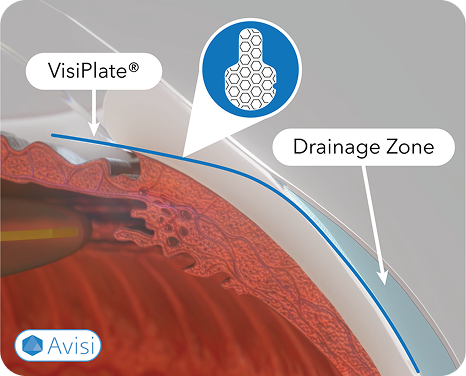
This space is located between the clear membrane of the eye, the conjunctiva, and the white of the eye, the sclera. The subconjunctival space has been used for decades to treat glaucoma. Historically, gold standard trabeculectomy surgery drains aqueous humor from beneath a scleral flap into a large pocket (often called a subconjunctival “bleb”), which sits under the upper eyelid. In contrast, VisiPlate drains aqueous humor directly into the subconjunctival space without a scleral flap or forming a large bleb, leading to a reduction of intraocular pressure (IOP).
VisiPlate: VITA Trial Results
Dr. Jonathan Myers of Wills Eye Hospital in Philadelphia, PA, USA presents the 1-year results of the VITA study.
The VITA study is a multicenter, prospective pilot study designed to assess the safety and effectiveness of Avisi Technologies’ investigational VisiPlate® device, enrolled and treated 15 subjects with open-angle glaucoma and no prior filtration surgery.
SAPPHIRE Study Testimonials
The SAPPHIRE study is a, Prospective, Multicenter, Single-Arm, Open-Label Clinical Trial – NCT07220876
Scientific Publications
- Myers, J. S., Miller-Ellis, E. G., Venter, L., Roux, P., Gous, P., De Bruin, M., Griggs, G., Vilupuru, S. (2025, October). Twelve-month effectiveness and safety outcomes of a novel, ultrathin, multichannel aqueous shunt in patients with OAG [Poster presentation]. American Academy of Ophthalmology Annual Meeting, Orlando, FL, United States
- Gallagher, J. (2025, March 4). Ultrathin Shunt Shows Promising Results in Trial. Glaucoma Physician.
- Miller-Ellis, E. (2023, May). A Multichannel Approach to a Better Bleb – Reviewing the design and development of a novel drainage device for glaucoma treatment. Glaucoma Today 2023 May/June; 30.
- Kao, B. W., Meer, E., Barbolt, T. A., Lewis, R. A., Ahmed, I. I. K., Lee, V., Nicaise, S. M., Griggs, G., & Miller-Ellis, E. G. (2021, June 21). Biocompatibility and feasibility of VisiPlate, a Novel Ultrathin, Multichannel Glaucoma Drainage device. Investigative Ophthalmology & Visual Science.
- Chan L, Moster MR, Bicket AK, Sheybani A, Sarkisian SR, Samuelson TW, Ahmed IIK, Miller-Ellis E, Smith OU, Cui QN. New Devices in Glaucoma. Ophthalmol Ther. 2023 Oct;12(5):2381-2395.
- Shivani S. Kamat, M. (2024, September 1). Next-generation drainage implants. Glaucoma Physician.